
If you’re searching for a WHS consultant NSW, something has probably triggered it.
A client wants WHS evidence. A tender is coming up. There has been an incident or near miss. Your safety documents are out of date. You’ve added workers, plant or new types of work.
Or WHS has simply become another job sitting with the owner or operations manager.
Getting professional help makes sense. But before choosing a provider, there is a more useful question to ask:
Do you need help with a specific WHS issue, or do you need someone helping you keep WHS managed across the business?
Those are two different needs.
What Does a WHS Consultant in NSW Help With?
A WHS consultant can provide specialist advice or complete a defined piece of safety work.
This may include:
- WHS audits and gap assessments
- risk assessments
- SWMS and procedures
- WHS management systems
- incident investigations
- compliance advice
- training
- specialist safety projects
If you need an independent audit, help investigating an incident or advice on a particular risk, consulting support may be exactly what you need.
The question is what happens once that work is finished.
The Bigger Problem Is Often What Happens Next
Say an audit identifies several corrective actions.
Who follows them up?
Your WHS documents are reviewed and updated. Six months later, you introduce new plant or change the way a task is performed.
Who checks whether anything needs updating?
A worker’s licence or training is approaching expiry.
Who is monitoring it?
A near miss is reported and actions are agreed.
Who makes sure they are completed?
A client suddenly asks for WHS evidence.
Is it already current and organised, or does someone need to stop what they are doing and pull everything together?
This is where many smaller businesses feel the pressure.
They may already know many of the things they should be doing. The problem is keeping the actions, reviews, records and responsibilities moving while everyone is also trying to run the business.
The issue is often not knowing what needs to happen. It is making sure it keeps happening.

When WHS Becomes an Ongoing Management Job
As a business grows, WHS usually becomes more involved.
There are more workers, supervisors and sites. More training and competency records need monitoring. Plant changes. Client requirements increase. SWMS need reviewing. Incidents and hazards create corrective actions.
No single task may be particularly difficult.
The challenge is keeping track of all of them.
Ask yourself:
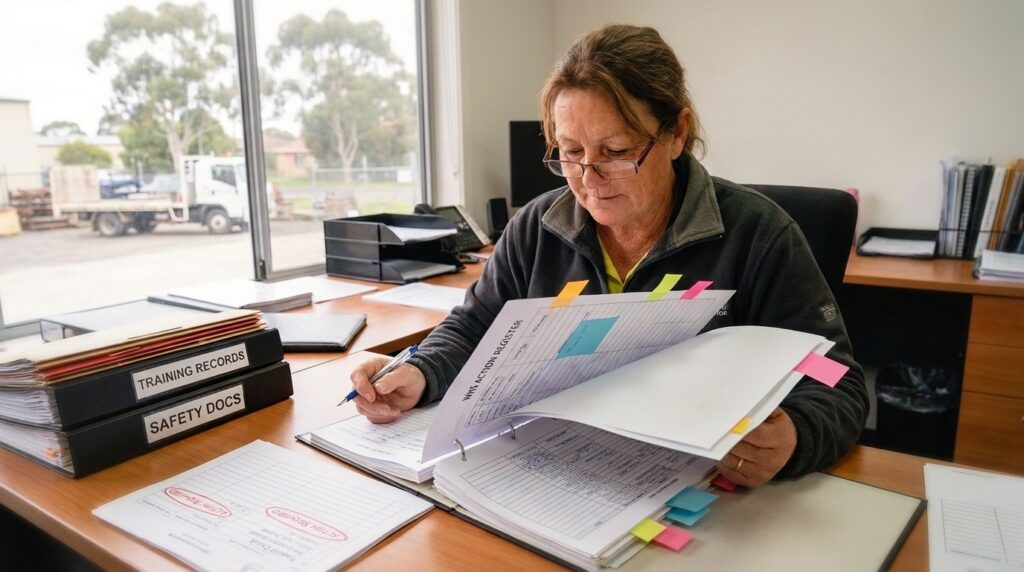
- Who keeps your WHS registers current?
- Who follows up outstanding safety actions?
- Who monitors training, licences and review dates?
- Who checks WHS documents when work changes?
- Who makes sure incident actions are closed out?
- Who keeps WHS evidence ready for clients or tenders?
- Who gives management visibility over what is still outstanding?
If the answer to most of those questions is the owner, director or operations manager whenever they find time, the business may not simply need more WHS advice.
It may need ongoing WHS management.
What Does Ongoing WHS Management Look Like?
Ongoing WHS management is the recurring work that keeps your safety system current and active.
Depending on the business, that can include:
- maintaining the WHS management system
- keeping registers and records current
- scheduling reviews and inspections
- monitoring training and competencies
- tracking corrective actions
- reviewing risk assessments and SWMS when work changes
- supporting supervisors
- coordinating incident follow-up
- keeping WHS evidence organised
- monitoring relevant WHS changes
It is not about creating paperwork for the sake of paperwork.
It is about having the structure and follow-through to make sure WHS work does not continually fall behind.
A useful way to think about it is:
WHS advice helps you understand what needs to be done. Ongoing WHS management helps keep it getting done.
What Kind of WHS Support Does Your Business Need?
Start with the problem.
| Your situation | Support that may suit |
|---|---|
| You have one defined WHS issue | Specialist or project support |
| You are unsure where your gaps are | WHS review or gap assessment |
| Actions keep falling behind | Ongoing WHS management |
| WHS continually returns to the owner or Ops Manager | Ongoing WHS management |
| Documents exist but nobody keeps them current | Ongoing management and review |
| Your operations have changed significantly | Review first, then determine the support needed |
There is no single answer for every business.
The important thing is to choose support based on what is actually causing the problem.
A Different Way to Get WHS Support
The Safety Dept. is designed for businesses that need WHS to be actively managed rather than treated as a series of separate projects.
We work through three stages:
Review
We look at what is already in place, what is working, what has changed and where attention is needed.
Implement
We work with your business to address the priorities. That may include systems, registers, risk assessments, SWMS, procedures or outstanding actions.
Manage
We stay involved to help keep reviews, records, actions and responsibilities current as the business changes.
That ongoing part matters because a WHS system is not something you finish once and put back on the shelf.
Your work changes. Your people change. Your plant changes. Client requirements change. New actions arise.
Someone needs to keep the moving parts organised.
What Should You Ask a WHS Provider?
Before choosing a safety consultant NSW or another form of WHS support, ask what happens beyond the initial work.
Useful questions include:
- Will you only identify our gaps, or help us address them?
- Who follows up actions after a review?
- How will our registers and documents stay current?
- What happens when our work or plant changes?
- Who monitors training and competency requirements?
- Will you work with our supervisors?
- What ongoing support is included?
- How will management know what is still outstanding?
The answers will tell you whether the service matches the problem you are trying to solve.
Your WHS Responsibilities Still Stay With Your Business
External WHS support does not transfer your legal responsibilities to somebody else.
Under NSW WHS requirements, the business still holds its duties, and officers have their own due diligence obligations.
External support can provide expertise, structure, administration and follow-through to help you manage those responsibilities properly.
That is an important distinction.
The goal is not to hand safety responsibility away.
It is to make sure your business has the support and systems needed to manage it properly.
So, Do You Need a WHS Consultant or Ongoing WHS Support?
If you are looking for a WHS consultant NSW because you have a defined safety issue, specialist consulting may be exactly what you need.
If you are unsure where your gaps are, start with a review.
But if WHS continually comes back to the owner or operations manager, actions are falling behind, records are difficult to keep current and nobody has clear oversight of what needs to happen next, the underlying problem may be ongoing management.
You may not need more safety paperwork. You may need someone helping you keep the safety work moving.
The Safety Dept. works alongside NSW businesses to Review, Implement and Manage WHS so the system stays current as the business operates and changes.
Not Sure What Kind of WHS Support You Need?
Start by looking at what is already in place, what keeps falling behind and which WHS tasks repeatedly return to management.